Normkompass
RAG with verifiable citations for German federal law.
Every answer points to the exact passage, for example "§ 14 Abs. 1 UStG". If the corpus does not support an
answer, the service refuses instead of guessing.






The demo corpus is German federal law from gesetze-im-internet.de. This is a reference implementation, not a finished product; see "Limitations".
This README is also published as a website: https://sotream.github.io/normkompass/.
Contents
Overview
Use it
How it works in detail
Results and limits
Project
Status
Reference implementation, all planned v1 phases implemented: project scaffold, corpus ingest with a structure-aware parser for the demo laws, hybrid search with a retrieval evaluation and an embedding comparison (ADR 0002), and answer generation with code-checked citations and refusal. It is not a finished product. See "Limitations" for what is not known or not done, in particular that the Claude runs are one run per model on questions that Claude wrote and the owner reviewed, and that the default search is hybrid with BM25 and citation matching, chosen by a rule fixed before the runs (ADR 0004), after an earlier hybrid scored below vector-only (ADR 0003).
How it works
flowchart LR
  subgraph offline ["Offline: ingest and index"]
    law["gesetze-im-internet.de<br/>5 federal laws"] --> parse["Parse by structure<br/>§ → Absatz → Nummer"]
    parse --> chunks["Chunks with citation label,<br/>title and Stand"]
    chunks --> db[("Postgres<br/>pgvector + full text")]
  end
  subgraph online ["Online: POST /ask"]
    q["Question"] --> search["Hybrid search<br/>vector + BM25 + citation matching"]
    db -.-> search
    search --> model["Answer model<br/>Claude, Ollama or OpenAI-compatible"]
    model --> check{"Code check:<br/>is every quote a verbatim<br/>substring of a retrieved chunk?"}
    check -- "all citations verify" --> ok["Answer + citations<br/>(source, path, URL, quote) + Stand"]
    check -- "any citation fails" --> refuse["Refusal"]
    search -- "nothing retrieved" --> refuse
    model -- "declines, bad output or error" --> refuse
  end
The model proposes an answer with quotes; the code, not the model, decides whether it is shown. One failed citation turns the whole answer into a refusal. A worked example with a real answer and a real refusal is in docs/worked-example.md.
Results at a glance
| What was measured | Result |
|---|---|
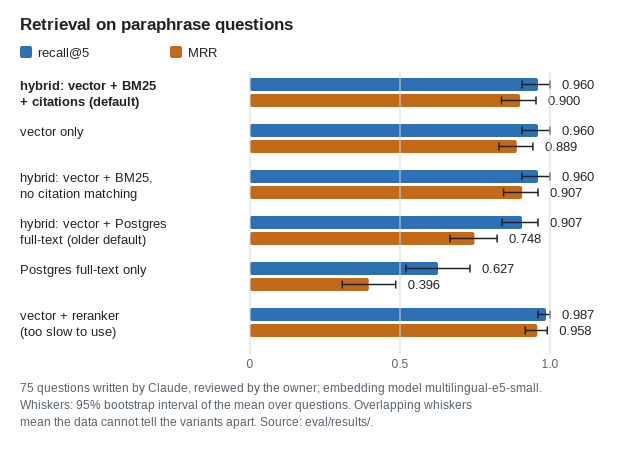
| Default search on 75 paraphrase questions | recall@5 0.960, MRR 0.900 on all 75; 0.946 and 0.901 on the held-out half (37), which was used to check the tuning (see Limitations); all 75 not significantly different from vector-only (0.960, 0.889) |
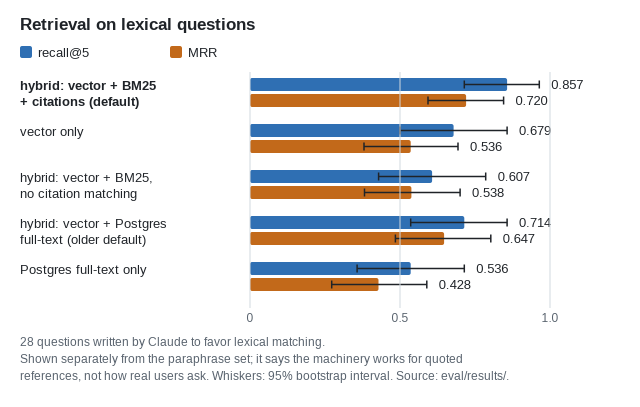
| Default search on 28 lexical questions (written to favor it) | recall@5 0.857, MRR 0.720, against 0.679 and 0.536 for vector-only |
Citation validity of a free hosted model (gemini-3.5-flash-lite, 4 runs) |
0.940 to 0.976 |
| Citation validity of Claude Opus 5.5 and Sonnet 5.5 (1 run each) | 1.000 for both (241/241 and 168/168); a single run per model on 89 questions, 2026-11-07, not a ranking |
Every figure comes from a recorded run in eval/results/; the charts below are generated from those
files and checked in CI. The paraphrase and lexical questions were written by Claude, the same model that wrote the
code, and the owner reviewed the 89 paraphrase questions; the sets are small, so read the
whiskers (95% bootstrap intervals), not only the bars. Full tables are in "Retrieval results" and "Answer
evaluation".
How this was built
The code, specs and documents in this repository were written by Claude (Anthropic's model, used through Claude Code), directed by the repository owner with a human in the loop. Work follows OpenSpec: every change started as a spec pull request that the owner read and merged before any implementation existed, and the implementation arrived as a separate pull request that the owner merged after review. The owner set the goals, the constraints and the acceptance criteria and decided at each gate. Commits are made under the owner's account. Who wrote the evaluation questions and corpus units is stated under "Limitations".
If you want to judge the engineering and the product thinking rather than take this page's word for it, these are the places where it is visible and checkable:
- Specs before code.
openspec/changes/archive/holds every proposal, design and task list, andopenspec/specs/the resulting behavior. The pull request history shows the spec-then-implementation order. - Decisions with stated rules. ADR 0001 (what may be processed, with cited sources) and ADR 0002 (the decision rule and where it was and was not fixed before the numbers were seen).
- Results that are not flattering are kept. The tables show a weak local model, hybrid search scoring below vector-only search, and a reranker that is too slow to use; "Limitations" lists what is unknown.
- A strict product rule enforced in code. An answer needs a citation whose quote is a verbatim substring of the retrieved text; any failed citation turns the whole answer into a refusal.
- Scope. What was deliberately left out (no UI, no auth, no promise of current law) is stated, not hidden.
Not legal advice
Output of this project is not legal advice and makes no promise that the law shown is current or complete.
Quick start
Requirements: Node 24, pnpm, Docker.
pnpm install
cp .env.example .env   # then set POSTGRES_PASSWORD
docker compose up -d   # Postgres with pgvector
pnpm build && pnpm lint && pnpm typecheck && pnpm test
pnpm ingest            # downloads the demo laws into .cache/ and prints a per-law summary
pnpm index             # embeds all units and stores them in Postgres (first run: model download, ~8 min)
pnpm eval              # same as pnpm eval:retrieval: recall@5 and MRR over eval/questions.jsonl; writes eval/results/
pnpm charts            # redraws docs/charts/*.svg from eval/results/ (pnpm charts:check verifies them)
The API (apps/api) exposes GET /health, POST /search with {"question": "...", "limit": 5} (ranked
chunks with source, path, URL and Stand) and POST /ask with {"question": "..."}, which returns
{answer, citations[{source, path, url, quote}], refused, stand}. /ask needs a configured answer model (see
"Answer providers"); without it the endpoint answers 503 and sends nothing to the network.
pnpm ingest fetches five laws from gesetze-im-internet.de one request at a time
(about 10 seconds), caches them, and reports units, skipped norms and the "Stand" of each
law. Pass -- --refresh to download again. See
ADR 0001 for the legal status of the data.
Corpus model
A law is split by structure: § → Absatz → Nummer. The retrievable unit is the Absatz; a §
without Absätze is one unit. Sentences (Satz) are not split, so citations are precise to
Absatz or Nummer, for example "§ 14 Abs. 1 UStG". A Nummer label such as "§ 14 Abs. 2 Nr. 1"
locates the list item inside the Absatz and omits any "Satz" qualifier of the official form.
The corpus is read through the CorpusSource interface in packages/corpus.
Process
Changes follow spec-driven development with OpenSpec:
specs live in openspec/, decisions in docs/adr/. Validate with pnpm spec.
Search
Chunks are the corpus units (Absatz, Nummer, or a whole norm). A unit longer than 1500 characters is split into parts at line or word boundaries; the parts keep the unit path. Each chunk is embedded with its citation label and title as a prefix ("§ 14 Abs. 1 UStG Ausstellung von Rechnungen ..."), while the stored text stays the original wording. The default search is hybrid: it merges three rankings with weighted Reciprocal Rank Fusion (k = 60): cosine similarity over the chunk embeddings (an exact scan; about 4,600 chunks, no ANN index), a BM25 ranking over the German-normalized words of each chunk (computed in the application, built at the first search), and, when the question names a citation such as "§ 14 Abs. 1 UStG", the chunks with that citation label. Query words that are German compounds are also split into parts known from the corpus vocabulary. Other configurations stay selectable and are measured: vector-only, Postgres full-text (query words OR-ed, or a strict AND query with fallback), a full-text weight, a filter for very common words. The default came from comparing them on a development half of the questions and confirming on a held-out half (ADR 0003, ADR 0004).
Embeddings come from multilingual-e5-small, run locally with transformers.js, so no text leaves the
machine after the one-time model download. It was kept after comparing four local models
(ADR 0002); a local reranker exists but is off by default.
Retrieval results
eval/questions.jsonl holds 75 German questions that the corpus answers and 14 that it does not. Each
answerable question lists the expected units and the place in the corpus it was derived from. A script
checks that every expected unit exists and that the words of each unanswerable question's topic
(absent_terms) occur nowhere in the corpus; it flagged seven wrong guesses while the set was written.
Seven questions are flagged needs_review; they were checked once in the same process that wrote the questions,
which reworded three of them (see ADR 0003), and have not been
reviewed by anyone else.
A returned unit counts as a hit if it is the expected unit or its parent Absatz or §. Recall@5 is the fraction of expected units hit in the top 5, MRR uses the first hit within the top 10. The 14 unanswerable questions are not used for these two metrics; refusal is evaluated with answer generation.
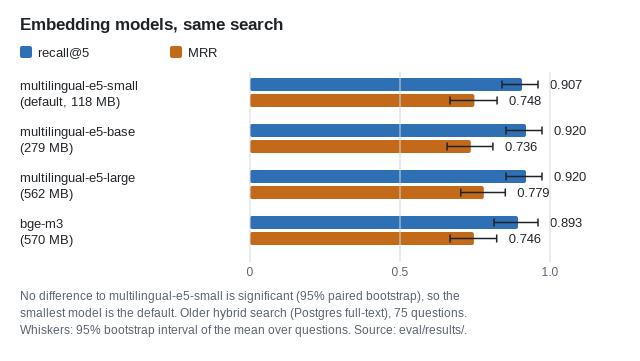
Table: paraphrase questions (eval/questions.jsonl, 75 answerable)
| Date | Commit | Embedding model | Search | recall@5 | MRR | Index time | Weights |
|---|---|---|---|---|---|---|---|
| 2026-11-04 | 9d9d041 |
multilingual-e5-small | hybrid: vector + BM25 + citation matching (default) | 0.960 | 0.900 | 229 s | 118 MB |
| 2026-11-03 | 5c9212a |
multilingual-e5-small | vector only | 0.960 | 0.889 | 229 s | 118 MB |
| 2026-11-04 | 9d9d041 |
multilingual-e5-small | hybrid: vector + BM25, no citation matching | 0.960 | 0.907 | 229 s | 118 MB |
| 2026-11-03 | 5c9212a |
multilingual-e5-small | hybrid: vector + Postgres full-text (older default) | 0.907 | 0.748 | 229 s | 118 MB |
| 2026-11-03 | 5c9212a |
multilingual-e5-small | Postgres full-text only | 0.627 | 0.396 | 229 s | 118 MB |
| 2026-11-03 | 5c9212a |
multilingual-e5-base | hybrid with Postgres full-text | 0.920 | 0.736 | 364 s | 279 MB |
| 2026-11-03 | 5c9212a |
multilingual-e5-large | hybrid with Postgres full-text | 0.920 | 0.779 | 5246 s | 562 MB |
| 2026-11-03 | 5c9212a |
bge-m3 | hybrid with Postgres full-text | 0.893 | 0.746 | 16719 s | 570 MB |
| 2026-11-03 | 4a0f7f6 |
multilingual-e5-small | vector + reranker (bge-reranker-v2-m3, top 20) | 0.987 | 0.958 | 229 s | 118 MB |
Table: lexical questions (eval/lexical-questions.jsonl, 28 answerable: 10 exact terms, 9 numbers, 9 citation lookups)
Written to favor lexical matching and reported separately; they are not averaged with the table above.
| Date | Commit | Search | recall@5 | MRR |
|---|---|---|---|---|
| 2026-11-04 | 9d9d041 |
hybrid: vector + BM25 + citation matching (default) | 0.857 | 0.720 |
| 2026-11-04 | 9d9d041 |
vector only | 0.679 | 0.536 |
| 2026-11-04 | 9d9d041 |
hybrid: vector + BM25, no citation matching | 0.607 | 0.538 |
| 2026-11-04 | 9d9d041 |
hybrid: vector + Postgres full-text (older default) | 0.714 | 0.647 |
| 2026-11-04 | fa54502 |
Postgres full-text only | 0.536 | 0.428 |
External question set (written by other AI assistants)
To test the lexical results against questions this repository's author did not choose, four batches of 16 to 24
corpus passages (seed 20261107, every law in every batch) were given, with the instruction in
eval/external/INSTRUCTIONS.md, to two assistants, each of which got all four batches
and wrote its own questions on the same passages: Perplexity and Gemini 3.6 thinking, as reported by the
repository owner (versions are not recorded and the repository cannot verify what produced a file). Perplexity's
outputs ended with a "Sources" line, which suggests an interface with web search; for batch d Gemini's paste also
contained its own code and a first draft, and only its final 16 lines are stored (see eval/external/raw/; everything
else is stored as received). Of 164 lines, 144 became questions and 20, all Perplexity's, were rejected with a
reason in eval/external/rejected.json (15 whose quoted term is not in the question verbatim, 1 copy of an existing
question, and 4 "Sources" lines that are not JSON). 62 of the 144 are flagged needs_review because the quoted term also
occurs in other passages, so the single expected passage is not the only defensible answer; 20 of Gemini's 38 flags
are "number" questions whose "number" is a reference such as "Nummer 1" or "Absatz 2". These are model-written
questions, not users' questions, each written while looking at the passage, so they quote its words and favor lexical
matching. Two writers are not a sample of writers.
Cells show recall@5 / MRR; "unflagged" leaves out the needs_review questions.
| Search (multilingual-e5-small) | all 144 | Perplexity 64 | Gemini 80 | Perplexity unflagged 40 | Gemini unflagged 42 |
|---|---|---|---|---|---|
| default: vector + BM25 + citation matching | 0.979 / 0.837 | 0.984 / 0.830 | 0.975 / 0.843 | 0.975 / 0.814 | 1.000 / 0.952 |
| vector only | 0.903 / 0.727 | 0.953 / 0.753 | 0.863 / 0.705 | 0.975 / 0.796 | 0.976 / 0.858 |
| vector + BM25, no citation matching | 0.840 / 0.698 | 0.719 / 0.601 | 0.938 / 0.776 | 0.550 / 0.422 | 0.929 / 0.821 |
| vector + Postgres full-text (older) | 0.750 / 0.584 | 0.656 / 0.534 | 0.825 / 0.625 | 0.500 / 0.405 | 0.810 / 0.621 |
Result files are eval/results/2026-11-07-multilingual-e5-small{,-vector,-nocitation,-fts-nocitation}-external.json
(commit b5d26fe; the first version of these files covered Perplexity's 64 questions only, and its per-question
ranks are unchanged in the files above). Paired 95% bootstrap intervals of the MRR difference, default minus
vector-only: +0.110 [+0.066, +0.157] on all 144 and +0.057 [+0.003, +0.116] on the 82 unflagged ones; by writer on the
unflagged questions, Perplexity +0.018 [-0.063, +0.104] (not significant) and Gemini +0.094 [+0.028, +0.174]. Default
minus the older hybrid: +0.253 [+0.184, +0.321] on all 144 and +0.127 [+0.049, +0.206] on the 91 term and number
questions.
Reading it: on questions written by two other assistants the default is ahead of vector-only (on the unflagged questions for one writer significantly and for the other not) and clearly ahead of the older Postgres hybrid, including on exact terms and numbers, which agrees with ADR 0005 that the earlier gap in favor of the older hybrid was noise. The earlier observation that vector-only is slightly better on citation lookups did not replicate: it held for Perplexity's short "Was regelt § ...?" questions (MRR 0.743 against 0.815, 27 questions, not tested) and was reversed for Gemini's (0.962 against 0.912, 26 questions), whose citation questions also name content, so it depends on how the question is phrased. This set was not used to choose the default.
How to read these (details and paired bootstrap intervals in ADR 0002, ADR 0003 and ADR 0004):
- The default is hybrid with BM25 and citation matching. On the paraphrase questions it is as good as vector-only (MRR +0.011, interval [-0.034, +0.056], not significant); on the lexical questions it is clearly better (MRR +0.185, [+0.081, +0.304]). The gain on the lexical questions comes almost entirely from citation matching ("Was regelt § 172 Abs. 1 AO?"): by style, citation lookups score 0.596 against 0.080 for vector-only. On exact terms and numbers the older Postgres hybrid scored higher (0.883 and 0.889 against 0.850 and 0.701), but that rests on three of 19 questions and the paired intervals include zero, so it cannot be told from noise (ADR 0005). That analysis also found that numbers written with a separator ("6.000") were split in the query and could not match; they are now kept whole, which changed no measured result because no eval question contains one.
- The choice was made on a development half of both sets and confirmed on a held-out half by a rule fixed before the runs. The lexical set is small and favors lexical matching by construction, so it shows that the machinery works for quoted references, not how real users ask.
- The four embedding models were compared in the older hybrid mode and are not significantly different from each other, so the smallest is the default; they were not re-run with the new default. The reranker was measured on vector-only candidates: it improves MRR significantly (+0.068) but recall@5 not significantly (+0.027, [0.000, +0.067]), and the first run took about 53 seconds per question on an Apple M1, so it is off by default and not part of the API.
- Compound splitting switched off gives identical numbers (only one paraphrase question is affected).
- Index times are single runs on a laptop that was not idle (the small model took 1141 s in one run and 229 s in another): read them as orders of magnitude. Cloud embedding models were not evaluated (no key).
Run a comparison with pnpm index --embedder <name> and
pnpm eval:retrieval --embedder <name> [--questions eval/lexical-questions.jsonl] [--mode vector|hybrid|fts] [--lexical fts|bm25] [--no-citation] [--fts-query or|and] [--rerank] [--no-compound] [--fts-weight w] [--fts-max-share s] [--bm25-b b] [--no-keep-numbers] [--split dev|heldout],
where the names are local-e5, local-e5-base, local-e5-large, local-bge-m3 and fake. Raw results are in
eval/results/ and pnpm eval:compare a.json b.json gives the paired bootstrap. pnpm eval:diagnose shows, per
question, where vector and full-text ranking place the expected unit, and pnpm eval:exact-terms compares the default with
the older hybrid on the exact-term and number questions. The commit shown is the head of the pull
request branch the numbers were measured on (a squash merge gives it a new hash). The runs are manual.
Weak spots, as measured with the default: 3 of 75 paraphrase questions have no expected unit in the top 10 (q030, q044, q057); on the lexical set 4 of 28 are not in the top 5. Among the paraphrase misses are general questions about the scope of a whole law, for example "Für welche Steuern gilt die Abgabenordnung?" (§ 1 Abs. 1 AO); the reason has not been analyzed.
CI runs a smaller eval on fixtures with a deterministic fake embedder (14 questions, thresholds recall@5 >= 0.7 and MRR >= 0.5; measured 0.786 and 0.652 in the default mode) against a Postgres service. It guards against regressions in the search code and says nothing about quality with a real model.
Bring your own corpus
Everything except the demo parser works on the CorpusSource interface (packages/corpus): name,
loadDocuments() (read the raw material) and split() (turn one document into units with a stable id, a
structural path, a citation label, a title and a URL). Index the units with indexUnits, search with
HybridSearch, and score with the functions in packages/eval against your own questions.
examples/own-corpus is a complete, small example: a folder of .txt files where a line starting with #
begins a section and each section is one citable unit. It is tested in CI (the adapter, and indexing plus a
search query against Postgres). Run it, with Postgres from docker compose up -d:
pnpm example "Wie viele Urlaubstage habe ich?"   # fake embedder, no model download
EMBEDDER=local-e5 pnpm example "..."              # real embeddings
It writes to its own Postgres schema, so it never mixes into the law index. The example documents are
invented text, not a real policy. The Markdown source under packages/corpus/test stays a test fixture.
Related projects
- normkompass-mcp: a small MCP server in Python that offers
this service's search and cited answers to an AI agent as two tools,
search_lawandask_law. It is a thin client of the HTTP API described under "Quick start" and adds no retrieval of its own. Status: reference implementation, version 0.1.0; it was run against this API with the MCP Python SDK's client on 2026-11-05, and not yet in a desktop MCP client (see its README).
Limitations
- The Claude runs are one run per model. Claude Opus 5.5 and Sonnet 5.5 were each run once on the 89 questions that Claude wrote and the owner reviewed, so there is no spread, and a difference of one question out of 72 is noise. They are not a ranking of the two models, and they say nothing about other question sets or real users (see "Answer evaluation").
- The lexical gain is shown on questions written to favor it. The default search (hybrid with BM25 and citation matching) beat vector-only on a 28-question lexical set that favors lexical matching by construction and was written by Claude; on the paraphrase questions it only matched vector-only. How it behaves on real users' questions or other corpora is not known; the external check is 144 questions from two AI writers, which quote the passages' words and are not users' questions (see "External question set"). On exact terms and numbers the default is not shown to be better or worse than the older Postgres hybrid (19 questions, differences within noise, ADR 0005).
- The reranker is not part of the service. It improves MRR significantly (recall@5 not significantly), but
took about 53 seconds per question on the development laptop, so it is off by default and not wired into
/ask. - Who wrote the corpus and the questions. The corpus is the official text of five laws from gesetze-im-internet.de (snapshot 2026-11-02); this project's parser cut it into units and made the citation labels, and no lawyer checked those units or labels. The 75 paraphrase questions, the 14 unanswerable questions and the 28 lexical questions were written by Claude, the model that also wrote the code, and none of them by a lawyer or any independent person. The owner reviewed the 89 paraphrase questions once, in the same process that wrote them; the lexical questions were not reviewed by anyone else. The system and its test share one author (self-bias). The 144 external questions were written by Perplexity and Gemini, as reported by the owner, from corpus passages, so they quote those passages.
- What is held out and what is not. The 75 paraphrase questions are split by number: odd numbers are the
development half (38), even numbers the held-out half (37); the 28 lexical questions are split the same way (14 and
14). The embedding model (multilingual-e5-small) was chosen on all 75 questions (ADR 0002), before the split
existed. The search default was chosen on the development halves, but the held-out halves were used as the gate of
the decision rules in ADRs 0003, 0004 and 0005 and are in 18 result files (
eval/results/*heldout*), so the held-out figures (0.946 recall@5, 0.901 MRR for the default) confirm a choice; they are not an untouched test. The diagnosis that led to BM25 and citation matching, and the lexical set itself, were made after looking at results on all 75 questions. The frozen protocol for a new, untouched set is in eval/PROTOCOL.md; that set has not been written yet and no result exists for it. - The sets are small and every number is one run. 75 and 28 answerable questions (38 and 37, or 14 and 14, per
half); seven paraphrase and six lexical questions are flagged
needs_review, three of the paraphrase ones were reworded after one review by their own author, and none was reviewed by anyone else. Differences of a few points between configurations are not meaningful, and four embedding models could not be told apart. Each model and each search configuration was measured once per question set, so there is no spread over repeated runs. - No human legal review. Nobody with legal training checked the expected units, the answers or the refusals. "Citation validity" means the quoted text is a verbatim substring of a retrieved unit (code check); it does not mean the unit supports the answer or that the answer is legally right.
- Compound-word handling is untested by the eval. Only one of 75 paraphrase questions contains a compound that the splitting touches.
- One corpus, one language, one snapshot. Five German federal laws, taken on 2026-11-02 with the "Stand" shown per law. The service makes no promise that the law shown is current or complete, and nothing is synchronized automatically.
- Citations are precise to Absatz or Nummer, not to Satz. Sentences are not split.
- Not legal advice. See the section above.
- Cloud embedding models were not evaluated (no API key was provided), and no cost or latency figures exist for hosted generation beyond the labeled runs.
- Out of scope for v1: a user interface, authentication, multi-tenancy, scheduled updates, deployment configuration, and EU law (DSGVO, EUR-Lex).
Answers and citations
POST /ask retrieves the 8 best chunks, gives them to Claude (through the Anthropic SDK) as numbered
sources, and asks for a JSON object with an answer and citations that refer to sources by number. The
code, not the model, then checks the result:
- a citation must point to one of the retrieved chunks, and its
quotemust be a non-empty, verbatim substring of that chunk's text (exact match, including whitespace and case); source,pathandurlare taken from the stored chunk, never from the model;- an answer needs at least one verified citation;
- if any single citation fails, the whole response is a refusal, with no partial answer.
A refusal is refused: true, an empty answer, no citations and stand: null. It is returned when
nothing was retrieved (the model is not called), when the model declines, when its output cannot be
parsed, when verification fails, and when the model call fails. For an answer, stand lists the Stand of
each cited law. The model id comes only from configuration. Corpus text and the question are passed as
data and the prompt tells the model to ignore instructions inside them; the checks above do not depend on it.
The strict refusal rule trades recall for trust: an answer whose quotes are copied sloppily is refused even if its content is right. How often that happens depends on the model and has to be measured.
Answer providers
ANSWER_PROVIDER selects the model behind /ask and the answer eval:
claude(default): the Anthropic API. SetANTHROPIC_API_KEYandANSWER_MODEL.ollama: a model running locally in Ollama. SetOLLAMA_MODEL(a model you have pulled) and optionallyOLLAMA_URL(defaulthttp://localhost:11434). Question and source text are sent only to that URL, so nothing leaves the machine.openai-compatible: any endpoint with an OpenAI-style chat completions API (for example the Google Gemini compatibility endpoint). SetANSWER_BASE_URL,ANSWER_API_KEYandANSWER_MODEL, and optionallyANSWER_MIN_INTERVAL_MSto space requests inside a free tier's rate limit. Question and source text (public law and the eval questions) are sent to that host, a third party, so do not use it with data that must stay private. Transient failures (429, 5xx, dropped connections) are retried with exponential backoff and jitter; a 429 also widens the spacing between requests.
There is no default model in the code for any provider. Keys go only in the git-ignored .env.
Citation verification and the refusal rule are identical for every provider. Results always name the provider and model; a local model's numbers say nothing about Claude and the other way round.
ollama pull llama3.1:8b                    # example; about 5 GB
# .env: ANSWER_PROVIDER=ollama and OLLAMA_MODEL=llama3.1:8b
pnpm eval:answers                          # 89 requests, runs locally
To use a free hosted model instead, create a key (for Gemini: Google AI Studio, "Get API key"), then in .env
set ANSWER_PROVIDER=openai-compatible, ANSWER_BASE_URL=https://generativelanguage.googleapis.com/v1beta/openai/,
ANSWER_API_KEY, ANSWER_MODEL (the available names change; GET <base url>/models lists them) and
ANSWER_MIN_INTERVAL_MS=6000, and run pnpm eval:answers.
Answer evaluation
pnpm eval:answers runs all 89 questions through the full pipeline with the real model and reports
citation validity (the share of proposed citations that pass verification), how often an answer cites an
expected norm, and refusal precision and recall (with "refused" as the positive class). It sends 89
requests to the configured model. With claude that costs money, so it is a manual command; with ollama
it is free but takes a while.
Results
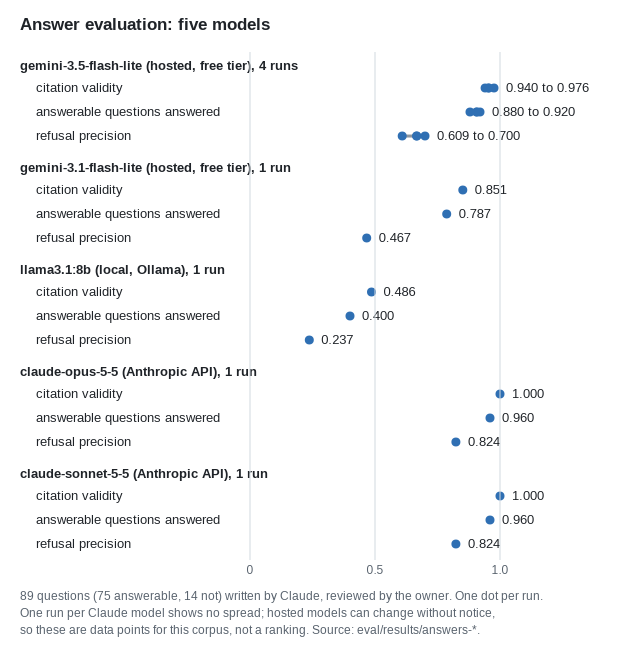
Table: answer evaluation runs
| Date | Commit | Answer model | Embedder | Citation validity | Cites expected norm | Refusal precision | Refusal recall |
|---|---|---|---|---|---|---|---|
| 2026-11-02 | abef35d (see note) |
ollama llama3.1:8b |
multilingual-e5-small | 0.486 (69/142) | 0.867 (of 30 answered) | 0.237 | 1.000 |
| 2026-11-02 | 7971384 |
openai-compatible gemini-3.5-flash-lite @ generativelanguage.googleapis.com, 4 runs |
multilingual-e5-small | 0.940–0.976 | 0.956–0.971 (of 66–69 answered) | 0.609–0.700 | 1.000 |
| 2026-11-02 | 7971384 |
openai-compatible gemini-3.1-flash-lite @ generativelanguage.googleapis.com, 1 run |
multilingual-e5-small | 0.851 (80/94) | 0.966 (of 59 answered) | 0.467 | 1.000 |
| 2026-11-07 | 327de90 |
claude claude-opus-5-5, 1 run |
multilingual-e5-small | 1.000 (241/241) | 0.986 (of 72 answered) | 0.824 | 1.000 |
| 2026-11-07 | 327de90 |
claude claude-sonnet-5-5, 1 run |
multilingual-e5-small | 1.000 (168/168) | 0.972 (of 72 answered) | 0.824 | 1.000 |
The first row is a small local model run on a laptop. Reading its numbers plainly: the
pipeline never accepted a bad citation, but the model is a poor fit for the task. Of the 75 answerable questions
only 30 were answered; 45 were refused, and all 14 unanswerable questions were refused (hence recall 1.0 and a low
precision of 0.237). Refusal reasons across all 89 questions: citation-rejected 44, model-refused 7,
no-citations 6, model-error 2. Most refusals come from the strict rule that any citation failing
verification (usually a quote that is not verbatim) rejects the whole answer.
The Gemini rows are Google models through the free tier (hosted third parties; question and source text were sent
to Google). gemini-3.5-flash-lite was run four times to see the spread: citation validity 0.955, 0.940, 0.954,
0.976; 66 to 69 of 75 answerable questions answered; refusal precision 0.609 to 0.700; all 14 unanswerable
questions refused every time. The main weakness is over-refusal: about 6 to 9 answerable questions are refused per
run, partly because a quote was not verbatim and partly because the model declined. No request failed. The raw
per-run files are in eval/results/ (...-run2.json and so on; the unsuffixed file is run 1).
gemini-3.1-flash-lite was clearly worse in its one run (more non-verbatim quotes, fewer answers). Hosted models
can change or be retired without notice and runs are not guaranteed repeatable, so these are data points for this
corpus and not a ranking. The commit 7971384 is the implementation branch before squashing, so it does not exist
on main under that hash.
Not measured, on purpose or for lack of access: gemini-3.8-flash and gemini-3-flash-preview (so overloaded or
slow on the free tier that no run finished in a reasonable time), gemma-4-26b-a4b-it (stopped, too slow on the
free tier), gemma-4-31b-it (the endpoint returned an internal error), and every model of Mistral and Groq (no
key; Groq's free tier also appears too small for a full run in a day).
Note on the commit: the recorded abef35d is a docs-only commit made before the provider code was merged
to main (as 595c501). The run was made from a local build of that provider code, but the recorded
revision does not identify it exactly, so treat the row as indicative and not exactly reproducible until
the run is repeated on main.
Claude runs
Both Claude runs used the defaults (hybrid search, 8 retrieved passages, the shipped prompt) through the
Anthropic API on 2026-11-07, one run per model, on commit 327de90. Cost, read from the organization's usage
page before and after each run: Opus 5.5 $2.23 (about $0.025 per question), Sonnet 5.5 $0.88 (about $0.010);
prices change, so this is the cost on that day. Of the 75 answerable questions,
72 were answered by each model; all 14 unanswerable questions were refused, so refusal recall is 1.0. Every
proposed citation passed verification (Opus 241, Sonnet 168; Sonnet proposed fewer citations per answer). Both runs have 17
refusals, all with the reason model-refused: none was rejected by citation verification and no model call
failed.
The two models refused the same three answerable questions, which is why refusal precision is 0.824 (14 of 17) for both. Re-running the search for them shows what is known: for q030 (which taxes the Abgabenordnung applies to) and q044 (who can be called in during an objection procedure) the expected unit was not among the 8 retrieved passages, so there the miss is in search and the refusal is consistent with what the model was given. For q027 (the deadline for a refund application) the expected unit was the top hit, and both models still refused; why is not established here.
What this shows: with these questions, Claude's citations were all verifiable and it refused every question the
corpus cannot answer. What it does not show: which of the two models is better (one run each, a difference of
one question out of 72), how stable the numbers are across repeated runs, or how Claude behaves on questions
written by other people or on other laws. The raw files are in eval/results/answers-2026-11-07-claude-*.json.
CI runs the same pipeline on fixtures with a scripted stand-in model that never touches the network. It checks that the code and the metrics behave correctly (a faithful model scores 1.0, a model that misquotes or answers unanswerable questions is detected); it does not measure any model.
License
MIT, see LICENSE. The demo corpus is not covered by it: the laws from gesetze-im-internet.de are not protected by copyright (§ 5 UrhG), see ADR 0001.